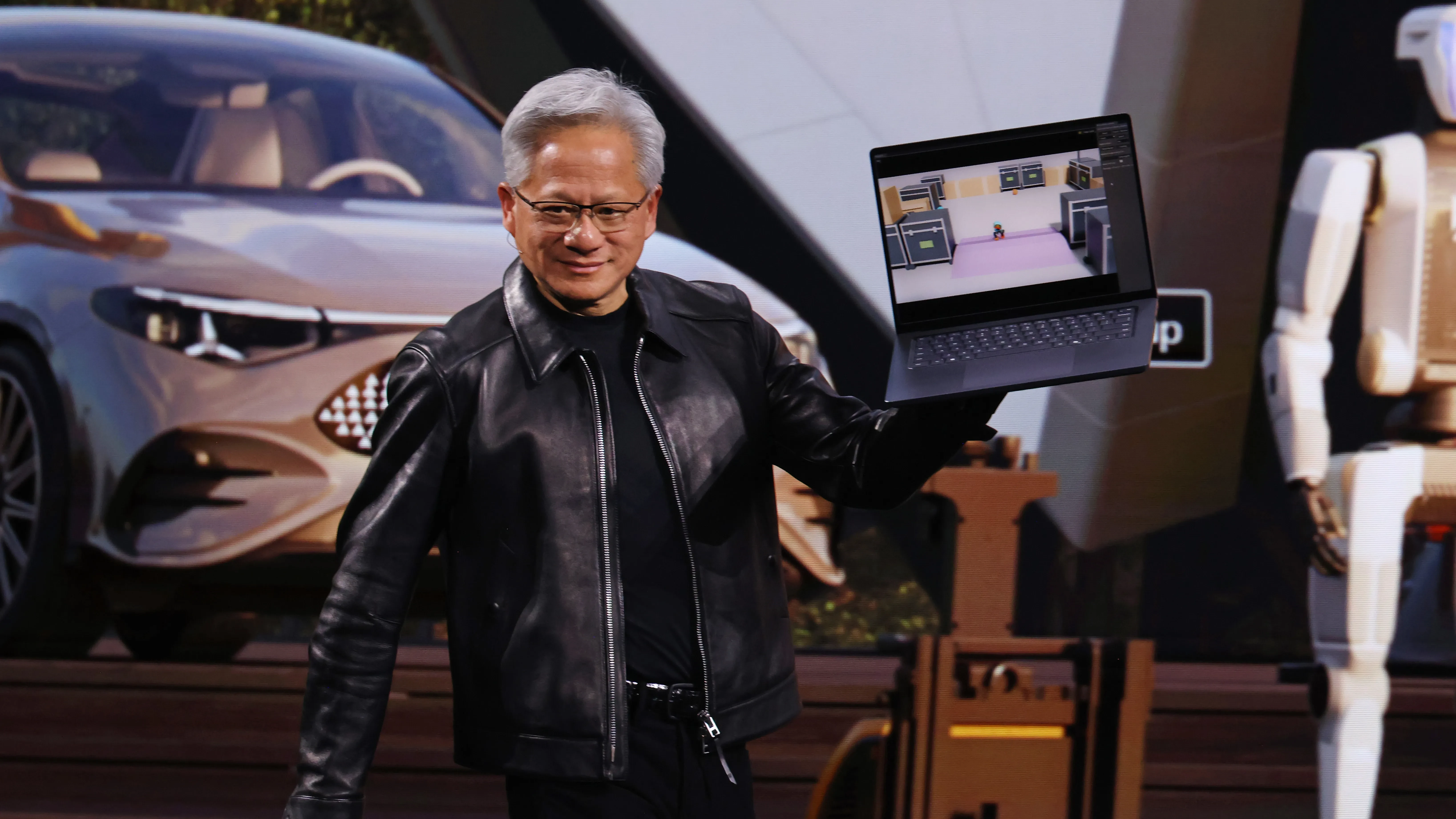
Jensen Huang Unveils Nvidia’s AI-First Vision For Europe At Berlin Global GTC Summit
Speaking at Nvidia’s Wednesday GTC regional conference hosted in Berlin, CEO Jensen Huang laid out a cohesive roadmap for Europe’s future anchored on three core pillars: advanced robotics, autonomous AI agents, and modular prebuilt data centers — with Nvidia serving as the foundational underpinning for the entire ecosystem, as expected.
“To thrive in this coming AI economy, you don’t want to just passively consume AI, you want to be the one producing it,” Huang told the 4,000-strong crowd of developers, industry partners and policymakers. “We can deliver every part of that vision right here, in Europe.”
The summit marked a clear thematic shift from Nvidia’s main March GTC event in San Jose, California, which focused heavily on AI inference optimization and high-efficiency compute design. Just seven months later, the Berlin keynote centered entirely on power infrastructure scalability, AI agent systems, and the category Nvidia dubs “physical AI”: embodied AI systems that operate in the real world outside of traditional data centers. The 90-minute keynote even closed with a playful live demo of tiny, cute Microduck robots built by Hugging Face — the open-source AI community Nvidia recently acquired — executing Huang’s on-stage commands.
The flagship DSX Pod: An AI factory that goes live in 14 days
Huang’s first marquee announcement was the DSX Pod, a fully modular “AI factory” purpose-built to eliminate the massive delays that plague standard AI data center construction. A 100% plug-and-play solution, every component of the DSX Pod ships pre-assembled inside a rugged standardized metal container, fully kitted out with Nvidia’s latest Vera Rubin generation compute racks. Instead of taking months or even years of on-site construction, permitting and setup to bring a new data center cluster online, a DSX Pod can be fully operational in just 14 days. That value proposition is particularly well-tailored for Europe, where large-scale infrastructure projects are notoriously bogged down by slow bureaucracy. Huang added that the rapid deployment timeline will also drastically cut the amount of time expensive compute hardware sits idle in data centers waiting for setup to wrap, calling the launch “a complete transformation of how we build AI infrastructure.”
Hosted at Berlin’s iconic Tempodrom, a venue modeled after a circus tent and decked out with the neon mood lighting of a dedicated gamer’s den, the keynote bounced seamlessly between targeted consumer laptop pitches and sweeping cross-industry predictions, positioning Nvidia as the non-negotiable core technology provider for every major global sector. Mid-speech, two Greenpeace protesters stood up and unfurled a banner reading “Clean up your dirty business”; Huang told his on-site security team to “go easy” as the activists were escorted out of the venue.
Physical AI, robotics and regional partnerships
Huang framed humanoid robotics as the “next great global industry”, arguing that Europe’s decades-long legacy of advanced manufacturing puts the region in a uniquely strong position to lead the world on the emerging tech. He also noted that physical AI extends far beyond humanoid machines: telecom operators across the continent are already installing Nvidia GPUs directly in cell towers to power low-latency edge AI workloads. He additionally announced expanded autonomous vehicle development partnerships with two leading European automakers, Volkswagen and Mercedes-Benz.
For the humanoid robotics ecosystem specifically, Huang unveiled a full-stack unified robotics platform built to standardize hardware and software configurations across different builds, alongside a pre-tested reference humanoid robot called Agile One, scheduled to launch in the first quarter of next year to give developers a ready-made base to build custom physical AI systems on top of. “This is your once-in-a-generation great opportunity,” he told the crowd.
Huang also shared key predictions for the wider AI ecosystem: every enterprise in the near future will run a mix of both off-the-shelf closed proprietary models and open-source models customized on their own internal private data, with Nvidia’s own open model line capable of hitting frontier performance levels after fine-tuning on proprietary datasets. He added that mass adoption of AI agents will unlock more active software tool users than ever before, as agents’ inherent demands for iterative reasoning, multi-step task planning and cross-tool access will push token consumption, total compute demand, and demand for Nvidia GPUs sharply higher.
For any attendees who found the 90-minute deep-dive too technically dense, Nvidia capped the keynote with a lighthearted AI-generated Eurovision-style pop song that summed up every major announcement — a wrap-up that was, by all accounts, far easier to follow than the full technical speech.
Jensen Huang Unveils Nvidia’s AI-First Vision For Europe At Berlin Global GTC Summit
Jensen Huang Unveils Nvidia’s AI-First Vision For Europe At Berlin Global GTC Summit