Backlash, Payroll, and the Meta Muse Logo: Jessica Hische on the Creative Community Firestorm
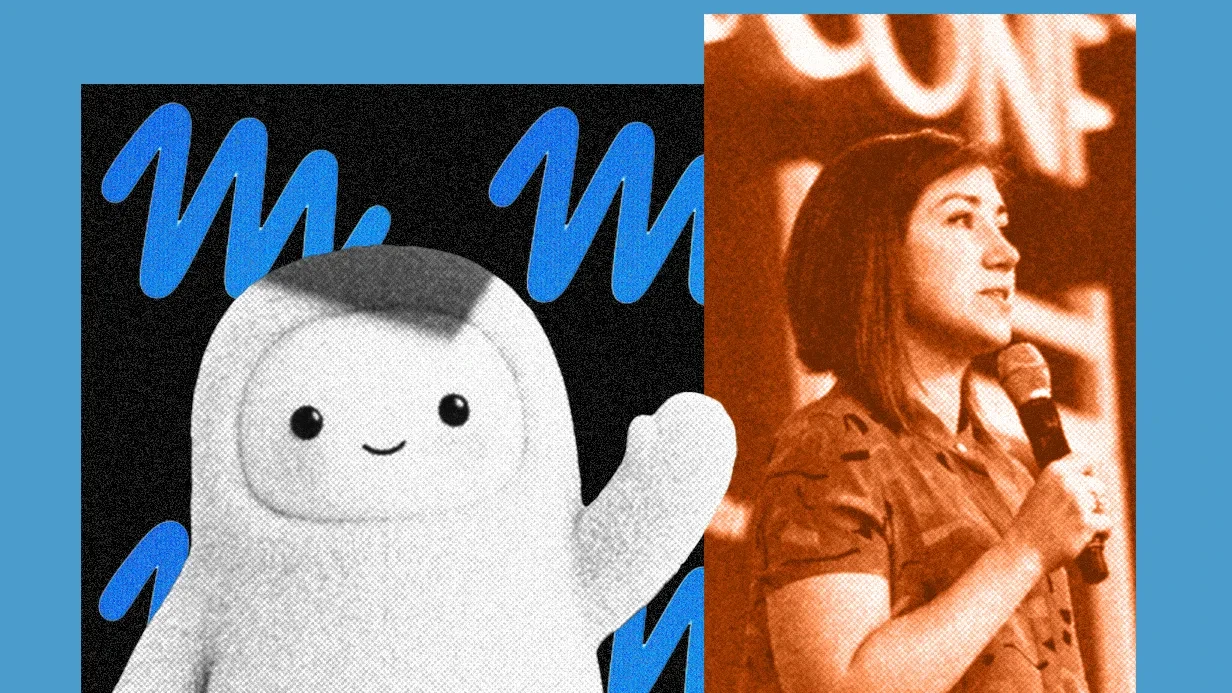
Bay Area celebrated lettering artist Jessica Hische walked into her recent freelance Meta contract fully aware the assignment was a political landmine. Tasked with designing the custom M monogram for the tech giant’s new AI assistant Muse, she knew both the AI space and Meta itself were massively divisive, widely hated subjects. “AI is such a third rail right now, and Meta is every bit as much of a third rail,” she told me over a recent phone call.
Still, as the small business owner operating two brick-and-mortar art and stationery shops in Oakland, she says the project payout was non-negotiable to keep her operations afloat amid tight cash flow. “New Work! (Don’t be mad at me),” Hische announced to her subscriber newsletter last month. “I collaborated with Meta to build an icon and custom logotype for their just-launched product, Muse — Meta’s official entry into the AI agent and personal assistant market. I know so many people have very complicated, strong feelings about both AI as a technology and Meta as a company, but this ended up being such a fun project for so many reasons.”
That announcement went viral almost immediately on Threads, where dozens of fellow professional designers criticized Hische publicly for selling out her values for a corporate check. She tried to de-escalate the criticism by laying out her small business context publicly: “For the past year, I’ve only ever had 2 to 4 payroll cycles worth of cash in my operating account at any given time. If you’ve ever run a small business, you know how precarious that level of cash flow is.” She went on to add she had poured $100,000 of personal capital into Studioworks, the administrative support platform she built for independent creatives, plus another $30,000 into Drawling, her Oakland kids’ art shop that hosts public classes and community workshops. “I have four people total on payroll: myself, my mom, and two full-time shop employees,” she noted.
None of those explanations softened the backlash. Comments ranged from blunt disgust (“This isn’t about money, it’s about ethics,” one user wrote, “I’m disgusted”) to violent metaphors comparing the contract to organized crime work: “Taking this job is like doing a hit for the mob, then acting shocked when the mob turns around and takes you out too.” Bad actors even posted photos of Hische’s home online and spread unsubstantiated rumors about her hidden personal wealth.
While Hische had expected some pushback from the tight-knit creative community, the ferocity of the harassment caught her completely off guard. Even for people who disapproved of Meta as a company, she reasoned, the firm deserved credit for hiring a human independent artist instead of churning out the logo via generative AI. The scale of the backlash, though, laid bare just how unpopular generative AI has become in many creative circles, to the point that any work for a major AI-focused tech firm is now widely seen as a betrayal of fellow artists.
We spoke last week about the ongoing online firestorm, her design process for the Muse logo, and the very specific unspoken request Meta’s team had to avoid a very unflattering logo shape. This interview has been condensed and edited for clarity and flow.
Zoë Schiffer: You opened your newsletter by acknowledging people have complicated feelings about both Meta and AI. Did that make you hesitant to take this project at first?
Jessica Hische: For the last year or two, my client contract work has been really slow, and that client income is what subsidizes my physical shops, because the brick-and-mortar businesses are not hugely profitable. My margins are razor thin. Between both shops combined, I only made about $10,000 in total profit last year. You can’t sustain a business and pay staff on $10,000 a year. So when the Meta project came around, I thought, great — I can get some steady cash in the account so I can make payroll and stop panicking every time a pay cycle rolls around.
What was the specific scope of the work you were hired to do?
I specialize in gentle logo refreshes. I redesigned Fender’s Squier brand identity, I reworked Jeni’s Ice Cream’s logo a few years back, and did the rebrand for Southern Living magazine. My whole philosophy for logo updates is that the brand should look like it went away for a weekend spa trip — not that it got a full, unrecognizable plastic surgery overhaul. You look at it and think, “Oh, something’s different, I can’t put my finger on it, but I really like it.”
Meta’s team had already done their own internal explorations of the M monogram, and they knew it wasn’t quite right. It was mostly product designers and engineers experimenting with type, and some of them are very skilled at typography, but drawing custom, polished letterforms is a super specific niche skill. They wanted me to refine the work they already had done on the M. It was an incredibly tight sprint just for that one letter: I finished the M in two days, and made 32 distinct versions of it. The full custom logotype took another two weeks on top of that.
What did they say their core goals were for the refreshed M?
Their original internal M was drawn as a single, uniform vector stroke, exactly the same width all the way around. When you work with a totally mono-weight stroke with no adjustments, there’s no subtlety to the shape at all, and that’s where the fun of custom type design happens. When strokes meet and join, they create a visually heavier dark pocket, those little rich inky moments type designers love. My whole job is playing with adding and subtracting tiny bits of weight to smooth those out.
Their big request was that they wanted the logo to feel inspiring and creative, to signal that Muse is a playful tool people can experiment with — not a rigid, engineered, cold piece of corporate tech.
How much does a project like this typically pay for you?
I charged what I thought was a really strong rate for a two-day sprint with a huge company, which came out to about $12,500. That’s a great amount of money to make in two days, don’t get me wrong, but it’s not life-changing wealth by any stretch.
Meta’s chief AI officer Alexandr Wang has been talking about the logo lately, saying he’s relieved it doesn’t look like a butthole, unlike some of Meta’s competitors’ logos. Was that a specific note you got from the team?
I do think “don’t make the M look like a butthole” was definitely a top-of-mind internal priority for them, for obvious reasons. But for my part, most of the conversations I had were about aligning the Muse monogram with Meta’s existing infinity loop brand identity, to make sure the Muse logo felt like it belonged to the same visual universe as the rest of their product portfolio.
Why did you decide to talk about this work publicly in your newsletter?
I love sharing my process and my finished projects with my audience, that’s why I publish the newsletter in the first place. Most of my long-time subscribers also know my husband worked at Meta for years, so they already understood I have an existing association with the company. I wanted to frame the announcement for an audience that already has context for both my relationship to Meta and my stance on AI, and acknowledge upfront that the project was a sensitive subject for a lot of people.
I saw you replied to a lot of the critics on Threads directly. Why did you choose to engage with them?
Usually, when there’s a misunderstanding going around online, I can reach out to the person posting and talk to them openly, say “I hear where you’re coming from” in a casual, non-confrontational way. I never set out to force people to agree with me — I just wanted to say, “I get what you’re upset about, but have you considered this other context?” That’s usually worked for me in the past to de-escalate conflict.
This time, though, I made a comment saying the project would keep me from carrying $50,000 in credit card debt over the holiday season for my shop inventory purchases, and someone took that completely out of context, claiming I was a rich heiress dropping $50,000 on Christmas shopping. Then the narrative spiraled completely out of control, and suddenly people were saying I was a kajillionaire sitting on a pile of gold yelling at poor, struggling artists — which is the exact opposite of my whole vibe.
What did that level of backlash feel like for you?
The first day I was replying to people, I wasn’t upset at all. I thought, “These people just don’t get that I’m a small business owner trying to pay my staff, this money lets me offer health insurance to one of my employees, this is a good thing!” I also didn’t use a single bit of generative AI for this project at all, and this is exactly the future we should all want: big companies choosing to hire independent human artists instead of churning out work with AI.
But then the backlash kept escalating, and it blew up way bigger than I ever could have imagined. It didn’t feel like a handful of designers talking about it — it felt like the entire Threads platform was piling on. The worst part was feeling so deeply misunderstood. I teach workshops, I never charge $1,500 for some predatory online course, my five-hour in-person workshops are only $35. I’m really intentional about the work I take on, I never say yes to something I feel morally conflicted over, and this didn’t feel like that kind of conflict at all, because I was getting paid for my human craft and didn’t touch AI once. I ended up feeling so sad, like I got hit by a truck. I spent two full days after the peak of the backlash lying in bed sobbing, convinced that all the good decisions I’ve made for my community, all the free educational resources I’ve put out over the years, had been for nothing.
Did you ever regret taking the project?
Not really. There was a group of people saying “It’s fine to take the work if you need the money, you just should have never told anyone about it.” But I thought I was doing something good for the creative community by praising a huge tech company that chose to hire a human artist instead of using generative AI to cut costs. That’s the precedent I wanted to set.
Where do you think all this anger from fellow designers is coming from? Is it just fear of AI taking their jobs?
That fear is 100% real. There are very tangible, justified fears about what generative AI is going to do to commercial art as a career. My husband and I fought about it for ages at one point: he was working on AI products and really excited about the technology, and I was completely staunchly anti-AI. Eventually I got to see the behind-the-scenes of low-level data processing infrastructure, all the ways non-generative AI is super useful for tasks completely unrelated to creative work, and that softened my stance a little. My husband also eventually came around to acknowledge how disruptive generative AI will be for working commercial artists, which helped a lot.
Most people working in AI go around saying “AI makes human art more valuable because it removes all the low-skill work!” which might be true for fine art, but that’s just not how the commercial art industry works. And the anti-AI purists are completely right that generative AI is built on stolen scraped art — I know my own books have been scraped for training datasets, so I’m actually expecting a payout from the ongoing Anthropic settlement. I never use generative AI to make art, I only use it for admin work, coding help, and web building. The line where it becomes a problem, for me, is any time AI is used to replace a human doing the actual creative, heavy-lifting work.
This is an edition of the Model Behavior newsletter. You can browse past issues here.
Backlash, Payroll, and the Meta Muse Logo: Jessica Hische on the Creative Community Firestorm
Backlash, Payroll, and the Meta Muse Logo: Jessica Hische on the Creative Community Firestorm